Where this shows up
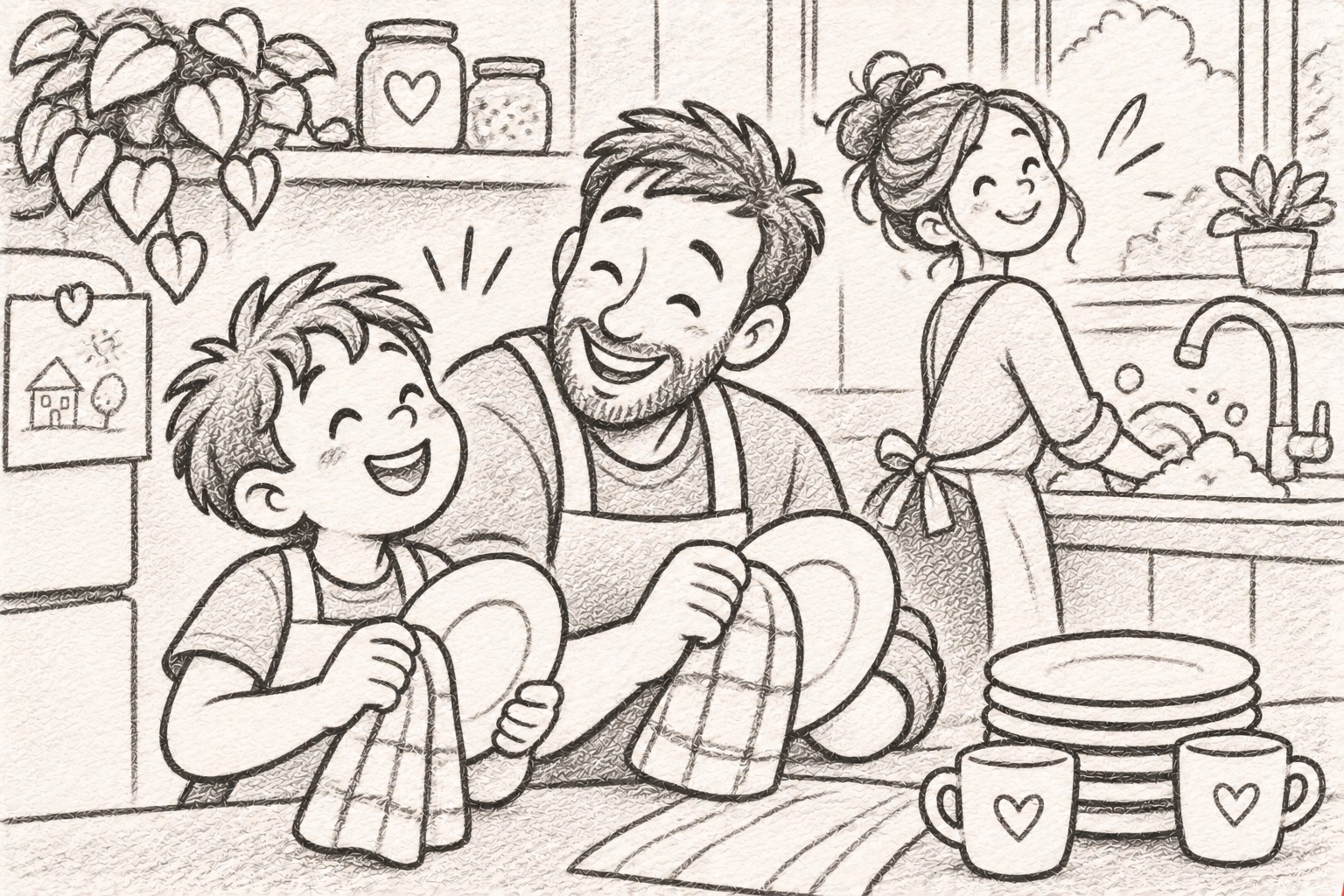
An ordinary Sunday in the kitchen between two adults. One washes dishes, the other dries and puts them away. At some point, one says with a smile: “Look, I’m helping you.” It is said with good intentions, free of malice or irony. The argument does not start there. It erupts two hours later over an unrelated trifle, leaving both partners wondering where the tension came from.
What we try first
Usually, we try to divide the tasks. We draw up chore charts, assign weekly shifts, and agree on who buys groceries and who cooks dinner. It functions smoothly for a few weeks. Then one partner begins reminding the other, reminders morph into micromanagement, and supervision escalates into pointless friction. The chore list was accurate, but it failed to heal the real point of pain.
What changes the picture
The word “helping” does not describe physical labor. It declares ownership—it defines who holds ultimate responsibility for the task.
We help someone who owns the project. If I wash the dishes and you “help” me, the cleanliness of the kitchen remains my burden. That is why the phrase, no matter how lovingly delivered, always lands on the same silent truth: I am carrying the load, and you are doing me a favor.
This is precisely what chore charts fail to capture. A home does not merely require execution; it requires three distinct layers: execution, remembering, and decision-making. Dividing execution is straightforward. Dividing the mental load—the invisible vigilance of remembering that pediatrician appointments are on Friday, that children have outgrown their shoes, and that the milk is running out—is vastly harder. The partner who holds the memory carries an invisible job that never clocks out.
The partner who asks “tell me what to do” is not lazy. They are simply an assistant awaiting marching orders in someone else’s venture. And the partner who issues directives is not inherently controlling; they are simply the sole owner. Both partners are exhausted by the very same imbalance, viewed from opposite sides.
True partnership only begins when an entire domain is handed over in full, complete with the right to make mistakes. Not “help me with the daycare logistics,” but “daycare is completely yours,” accepting that they may handle things differently than you would.
The same dynamic at work
This is the difference between delegating a task and delegating responsibility. A task is handed over with a sentence; responsibility is handed over only when you stop checking up. A manager who distributes tasks while hoarding ownership ends up with a passive team that waits for orders and notices nothing independently.
What you can do today
Choose one domain you currently manage alone and transfer it entirely to your partner before the week ends. Not a single subtask, but the entire domain. And allow it to be imperfect on the first attempt without stepping in.
The underlying habit
Think win-win. In a home, this does not mean a sterile fifty-fifty split of every chore. It means neither adult behaves like a polite houseguest offering assistance in someone else's residence. A family agreement is healthy when both partners stand as equal co-owners of their shared life.