
Where this shows up
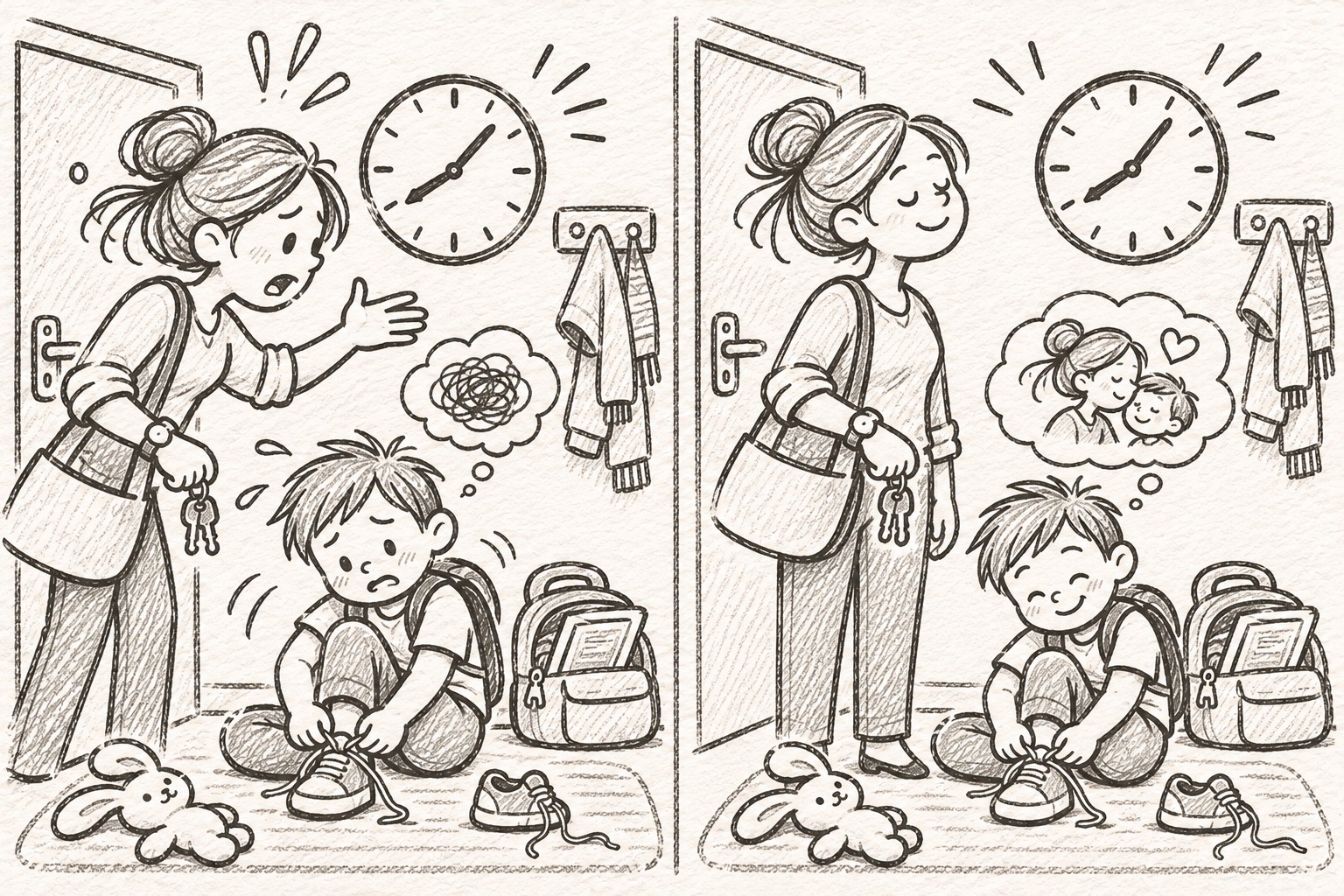
An ordinary morning. You hold a jacket in one hand and car keys in the other. You watch your child sitting by the front door, gazing at their sneaker as if examining a curious artifact for the very first time. You tell them to hurry up. Then you repeat it. Then a third time, in a slightly sharpened voice where tension has begun to fray the edges. Once you sit in the car, your pulse settles. You tell yourself nothing truly happened: nobody shouted, nobody wept, and everyone arrived on schedule.
That is precisely why this phrase escapes our scrutiny. It is not an explosive argument or a harsh punishment. It is merely an unremarkable phrase we utter fifty times a week.
What we try first
We try to buy more time. We set the alarm ten minutes earlier, lay clothes out the night before, or purchase shoes with velcro straps. It helps for three or four days. Then those precious ten minutes dissolve into the morning air, and we find ourselves standing in the hallway once more, repeating the very same words. The core problem was never the clock.
What changes the picture
“Hurry up” is not an instruction directed at a child. It is an adult invoice that the child is forced to pay.
We design our days around adult velocity and packed commitments because we know every destination and every consequence. In that schedule, a child has no sovereign pace; they are merely expected to keep up. When we run behind, we are not asking them to be quick. We are asking them to bridge the gap between an overbooked schedule and the finite reality of human hours.
What a child absorbs from perpetual rushing is not time management. They internalize the belief that their natural tempo is inherently inconvenient. When heard morning after morning for years, the specific words fade, but the somatic imprint remains: a lingering anxiety that they are forever falling behind, that others are perpetually waiting on them, that who they are is never quite fast enough. That feeling endures long after velcro gives way to shoelaces.
This cannot be resolved with tighter scheduling. It is resolved by courageously admitting that twenty-four hours cannot hold everything. Some commitments must be pruned. Until we cut them out, we will continue billing the difference to our children.
The same dynamic at work
A deadline is never shortened simply because a manager tells a team to move faster while the scope remains untouched. The work does not shrink; the anxiety simply migrates downward. A team constantly ordered to sprint does not become faster—it becomes a team that stops speaking up when delivery dates are genuinely unfeasible.
What you can do today
Count, without shame or judgment, how many times you say “hurry up” today. Just notice the raw number. Most parents are startled by the count, and that quiet awareness is worth far more than any rigid resolution.
The underlying habit
Put first things first. True priorities are never proven by what we proclaim to value, but by what we refuse to sacrifice when hours get crowded. If a child’s developmental pace is the first item tossed overboard, we have already chosen our priorities—just not the ones we would ever say aloud.